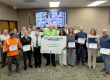
Dr. Pei-Sung Lin has been awarded the Outstanding Research Achievement Award by USF Research and Innovation, recognizing his impactful contributions to transportation safety, workforce training, intelligent transportation systems, infrastructure resilience, and innovative mobility solutions. He was honored alongside other distinguished faculty at the USF Faculty Honors & Awards Ceremony on April 15, 2025. The award includes a $7,000 research stipend.
This prestigious award celebrates faculty who demonstrate exceptional accomplishments in research and creative activity, with strong potential for continued high-impact contributions.
Dr. Lin, PhD, PE, PTOE, FITE, serves as the Director of the Intelligent Transportation Systems (ITS), Traffic Operations, and Safety Program at CUTR. He also holds a courtesy faculty appointment in the Department of Civil and Environmental Engineering. Additionally, he leads the Florida Local Technical Assistance Program (LTAP) Center, where he spearheads statewide initiatives to strengthen the transportation workforce and improve safety and operational efficiency for local agencies. Under his leadership, the Florida LTAP Center has become a premier training hub, attracting participants from around the world.
Over the past five years, Dr. Lin has secured more than $13.6 million in research funding, focusing on transportation safety, traffic operations, intelligent systems, infrastructure resilience, and mobility innovation. His work as Principal Investigator on several Florida Department of Transportation (FDOT) projects earned National Roadway Safety Awards in both 2021 and 2023. His research is widely published in peer-reviewed journals and presented at leading conferences.
Q&A with Dr. Pei-Sung Lin
What is your vision for the future of transportation?
“I envision a smart, safe, and sustainable transportation future—powered by innovation, AI, and resilience. Technology will enhance mobility, protect all users, and foster connected communities with a high quality of life across all regions.”
What trends do you see shaping tomorrow’s research?
“Future research will emphasize proactive safety, congestion mitigation, connected systems, and adaptive infrastructure. Leveraging AI, digital twins, and big data, we’ll deliver real-time, community-centered transportation solutions.”
Can you share some notable research studies and their outcomes?
“I’ve led research across various transportation domains, with significant contributions in wrong-way driving (WWD) and pedestrian/bicyclist safety. My FDOT-funded and NCHRP-supported WWD studies led to statewide implementation in Florida and influenced national practices. In pedestrian and bicyclist safety, I’ve conducted multiple studies identifying risk factors, evaluating countermeasures, and recommending cost-effective solutions—resulting in measurable safety improvements across Florida and informing national strategies to reduce fatalities and injuries.”
What are you most excited to work on next?
“I’m excited to lead new research and LTAP training initiatives focused on proactive safety using video analytics and near-miss data, enhancing non-motorized user safety with emerging technologies, developing innovative backup power systems for traffic signals, improving roadway safety through pavement friction and markings, applying AI to mobility challenges, and supporting Florida’s future connected infrastructure, arterial operations, and work zone safety planning.”