This spring marked an important milestone for public transportation in Hernando County, Florida, as two new transit routes—Routes 10 and 11—began service on May 4, 2026. Behind the scenes, the Center for Urban Transportation Research (CUTR) at the University of South Florida, through its Transit Management and Innovation (TMI) Group, played a key role in guiding the project from long-range planning to a successful public launch.
From Planning to Pavement

The new routes are the result of ongoing technical assistance provided by CUTR under a partnership with Hernando County Transit (TheBus). Identified through the County’s Transit Development Plan (TDP), Routes 10 and 11 were designed to close critical gaps in the existing network expanding access to essential destinations like grocery stores, healthcare facilities, and job centers in both Spring Hill and northern Hernando County.
Route 10 (Spring Hill Connector) improves east-west mobility through a dense residential corridor, while Route 11 (North Hernando Connector) extends service north along US-19 into Citrus County, restoring an important regional connection for residents traveling across county lines.
This project reflects CUTR’s commitment to helping communities not only identify public transportation needs, but implement practical, feasible service where it is needed most—planning that doesn’t sit on a shelf, but translates directly into real service on the street. The same CUTR team that developed the TDP also supported the routes’ launch, ensuring continuity from concept to implementation—and will continue to help Hernando County evaluate how the new services perform and advise on where resources can be best allocated for optimal ridership and mobility.
Meeting the Community Where They Are
A central focus of the project was ensuring that residents knew about, and felt confident using, the new routes from day one. CUTR supported a targeted outreach strategy that emphasized meeting people where they already gather.
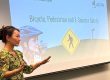
In April, the team participated in two well-attended community events—Pedal Play Day in Brooksville and the Brooksville Downtown Street Market—where they staffed booths, distributed printed materials, and answered questions about the new routes. These in-person touchpoints were complemented by social media campaigns, an official County press release, and a digital feedback form accessible via QR code.

The outreach approach paid off. Community members expressed strong interest in the new service and shared how it could impact their daily lives. Parents noted new options for young adults entering the workforce, while others highlighted the benefits for older family members needing transportation to medical appointments.
One attendee summed up the sentiment simply: “I love it! It’s been a long time coming.”
Building Awareness and Opportunity
For a growing, largely exurban county like Hernando, awareness is often the biggest barrier to transit use. CUTR’s outreach efforts were designed to overcome that barrier by providing clear, accessible information through multiple channels, from printed route maps and schedules to online tools and mapping integrations.
In addition to outreach, CUTR supported technical elements critical to a smooth launch, including ensuring that route information appears correctly in trip-planning apps such as Google Maps and Apple Maps, and coordinating with neighboring transit providers in Pasco and Citrus counties to maintain accurate regional connections.
The result is a more visible, more connected transit system that better reflects how residents actually live, work, and travel—often across county lines.
A Scalable Model for Small Transit Agencies
Hernando County Transit is a relatively small system, but through its partnership with CUTR, it gains access to a broad suite of technical expertise, from Title VI compliance and asset management to service planning and public engagement.
The Routes 10 and 11 launch highlights how this model can work elsewhere. By combining long-term technical assistance, data-driven planning, community-centered outreach, and multi-jurisdictional coordination, smaller transit agencies can successfully deliver meaningful service improvements.
Looking Ahead
The launch of Routes 10 and 11 is just one step in an ongoing collaboration. CUTR continues to support Hernando County with initiatives including Transit Asset Management planning, annual TDP updates, and the development of a standard operating procedure for future route expansions.
For the community, success will be measured not just by awareness, but by sustained ridership growth and continued engagement. Residents are encouraged to ride the new routes and share feedback to help shape future improvements.
As Hernando County Transit Administrator Darlene Lollie shared,
“The CUTR Team was critical in helping Hernando County Transit staff, residents, and community leaders better understand existing transit services and needs—and the value of adding new services and mobility options in areas previously unserved.”
With strong partnerships and a clear vision, Hernando County is proving that even small systems can deliver big impacts—connecting people to opportunity and strengthening mobility across Florida’s Adventure Coast.